The Amazing Compliance Race
Overview
This is a compliance training course for financial advisers that employs gamification and real-life scenarios to teach them responsible use of AI within a “SAFER” framework.
Shows how to use AI-powered LXD/ID with Custom GPT to get real-time, individualized feedback and adaptive learning design.
*Even though Pinnacle Wealth is fictitious, the problems they confront are based on real research and discussions with advisors in the field.
Timeline
6 weeks (research, design & development)
My Role
Instructional Designer
Tools
Miro (ideation & mapping). Articulate Storyline (course creation), ChatGPT (workflows & course custom GPTs) Vyond (animations) Figma (visual design)
Goal
Reduce AI-related compliance issues in client-facing communications by 25% within 90 days.
Challenge
Pinnacle Wealth, a registered investment advisor managing $2.1B in assets, was having trouble with AI adoption. Banning AI outright risked falling behind competitors, but uncontrolled use posed serious compliance exposure. At the same time, their 42 advisors still spent 60% of their time on routine, low-value tasks.
Because of this, they had less time to do important work, like personalizing Mrs. Chen’s quarterly portfolio review or preparing a $2.3M wealth plan for a potential client.
Even though they had spent money on an enterprise AI solution to help its 42 advisers work more efficiently and stay compliant, the outcomes six months after it was implemented were not satisfactory.
The Compliance Crisis:
Instead of safe use, complaints of compliance incidents surged-exactly the regulatory risk the platform was meant to reduce.
The Productivity Stagnation:
The idea had been to get back time for important tasks, like customizing that $2.3 million wealth plan.
Instead, advisers continued to spend a similar amount of time on mundane activities because they were unsure about how to use the AI tool safely for more important work.
They needed advisors to understand what the tool could do, how to use it compliantly, and when it fit their workflows.
That’s when Pinnacle’s Chief Compliance Officer got in touch with me.
Insight
As the only instructional designer, my first question wasn’t what to build—it was whether training was the right intervention.
My approach:
My method is to look at each project as a diagnosis. I get feedback from people at all levels of the company, including end users, supervisors, compliance officers, and leaders. This is because each group perceives a different part of the problem.
The organized stakeholder launch call made it evident that Pinnacle had spent money on compliant technology and made sure that advisors knew the laws. However, Pinnacle left it up to the advisers to determine how to apply that information in their daily work. They didn’t have a way to consistently evaluate inputs, analyze outputs, or make archiving decisions when working with real clients. This led to uneven usage, more reluctance, and unnecessary compliance risk.
To confirm this, I had informal interviews with five financial advisors at similar companies and put together what I learned from leaders and compliance stakeholders. These showed clear patterns: advisers knew the rules and were afraid of breaking them, but only a handful were utilizing a repeatable framework to make sure AI was used safely in real work. Some stayed away from AI due to uncertainty and the lack of time needed to figure out how to use it safely and effectively. Others used it too much without clear rules.
0
were using a framework for safe AI usage
80%
reported workloads affecting work quality
100%
cited compliance as their primary concern
20%
were using AI daily
The critical insight:
This wasn’t a lack of knowledge or technology so much as a gap in the workflow. Advisors lacked a practical and repeatable method to consistently apply compliance judgment in their work with AI.
Based on my experience in UX and instructional design, I decided that an asynchronous eLearning course with hands-on practice and skill certification would provide advisors the confidence and automaticity they required to use compliant AI techniques in real client workflows all the time.
Once I figured out the core cause, I worked with compliance leadership to set a clear business goal for the intervention:
Reduce AI-related compliance issues in client-facing communications by 25% within 90 days.
Solution
I designed a gamified, scenario-based eLearning course-The Amazing Compliance Race. There are 4 race “legs” that are based on real advisor processes and personality.
Advisors are competitive, driven, and used to learning difficult abilities quickly when they need to. By framing compliance as a skill to practice instead of rules to follow, the training fit with how they really work.
Learning through scenarios was important. Advisors didn’t have enough experience using AI compliance knowledge in real life. Each leg shows real-life workflow situations, like client emails, study summaries, and communications. It also shows what data to redact, how to write safe and efficient prompts, how to evaluate AI output, and what information needs to be archived. Scenarios help people learn how to make decisions and do things automatically.
The training is self-paced. Advisors work at different branches on different schedules; therefore synchronous training would be a more time-intensive, expensive solution. Certification created responsibility and still gave leaders a clear adoption metric.
The Four Leg Structure
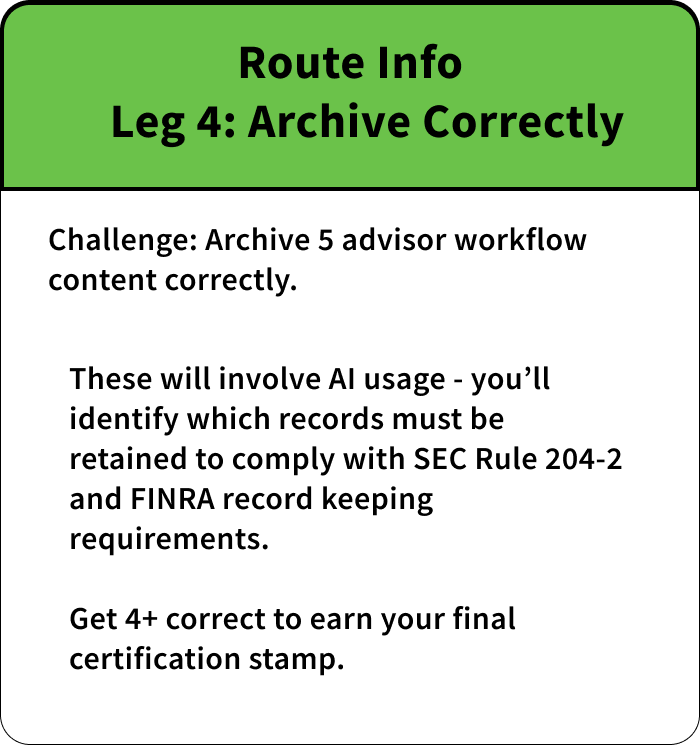
Each of the four race “legs” starts with a custom Route Info card that explains the challenge, gives real-world examples and sets clear success criteria. This keeps the race metaphor going while keeping a professional tone.
I created two frameworks to anchor behavior in daily workflows


AI-Powered Feedback
To scale meaningful practice without building dozens of branching paths, I integrated a Custom GPT trained on 2 frameworks and relevant regulations. Advisors submit realistic prompts and receive personalized, context-specific feedback. Here, AI wasn’t just the subject of the course—it enabled higher-quality learning design.
Design Artifacts
Click to expand.
Action Map
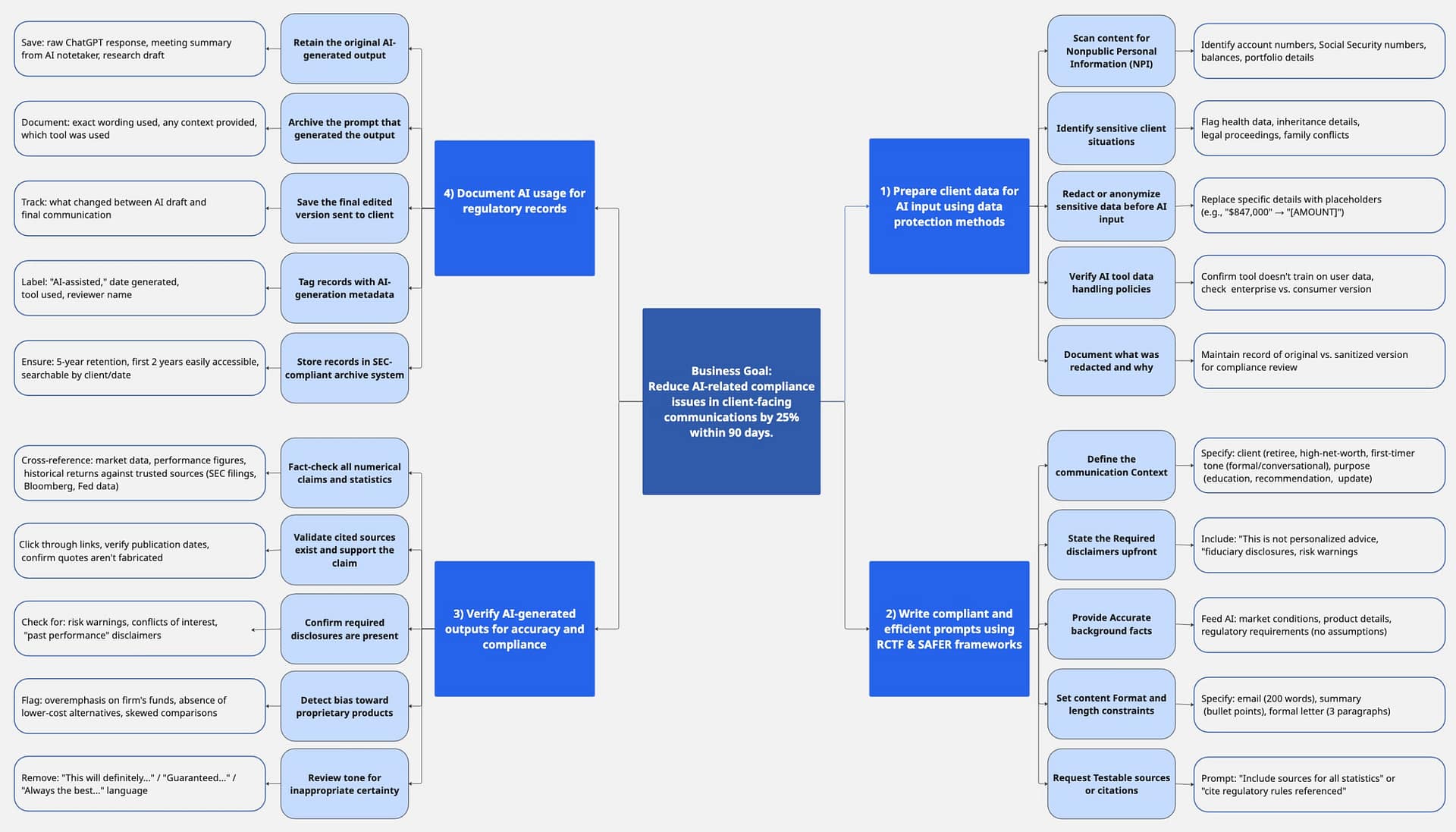
Aligned 25% reduction goal to performance objectives and practice tasks. Built from SEC/FINRA research and advisor workflow analysis (self-directed so no SME access).
Learning Design Plan
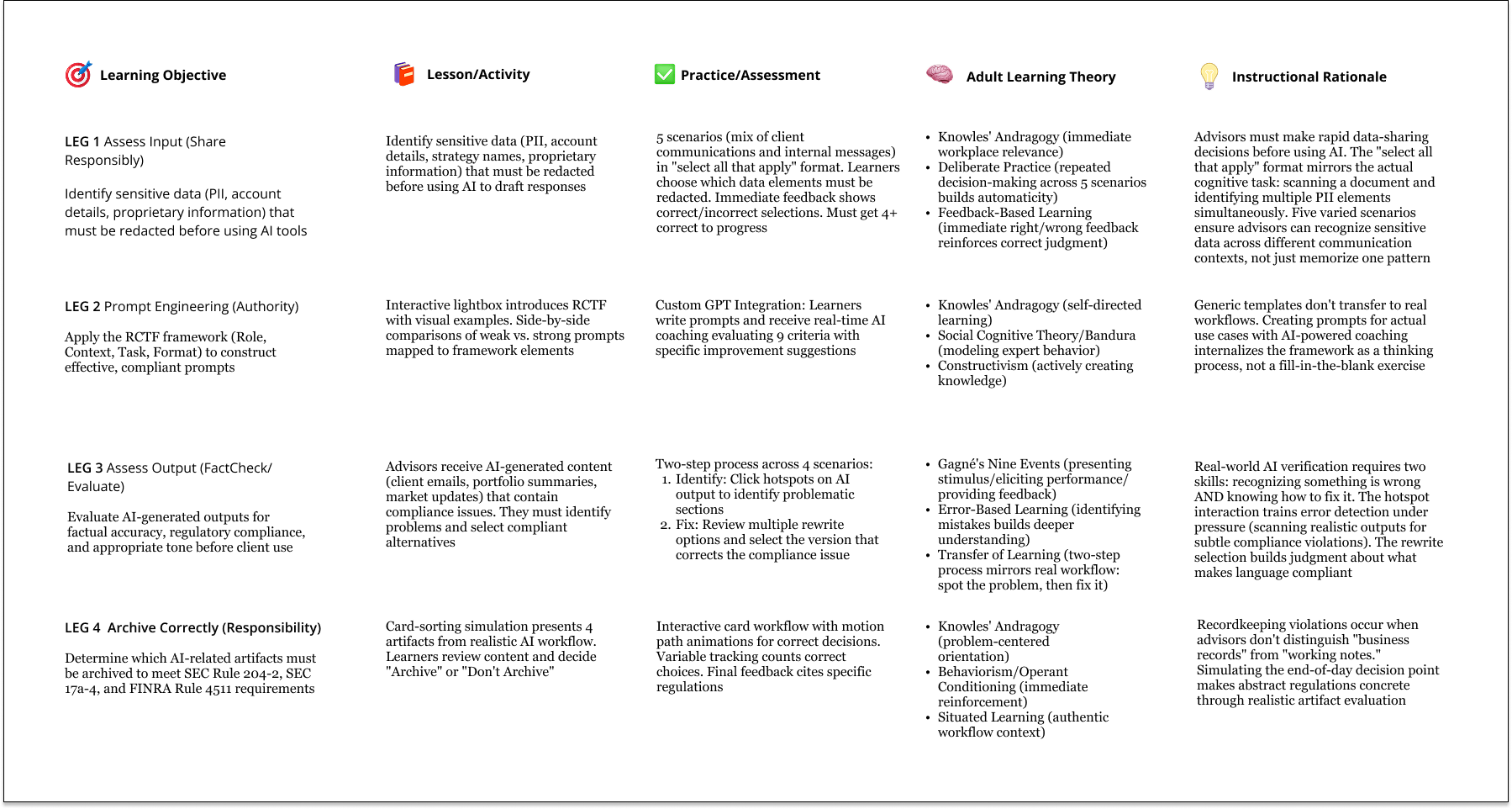
Mapped each leg’s objective to practice, assessment, and adult-learning rationale.
Storyboard
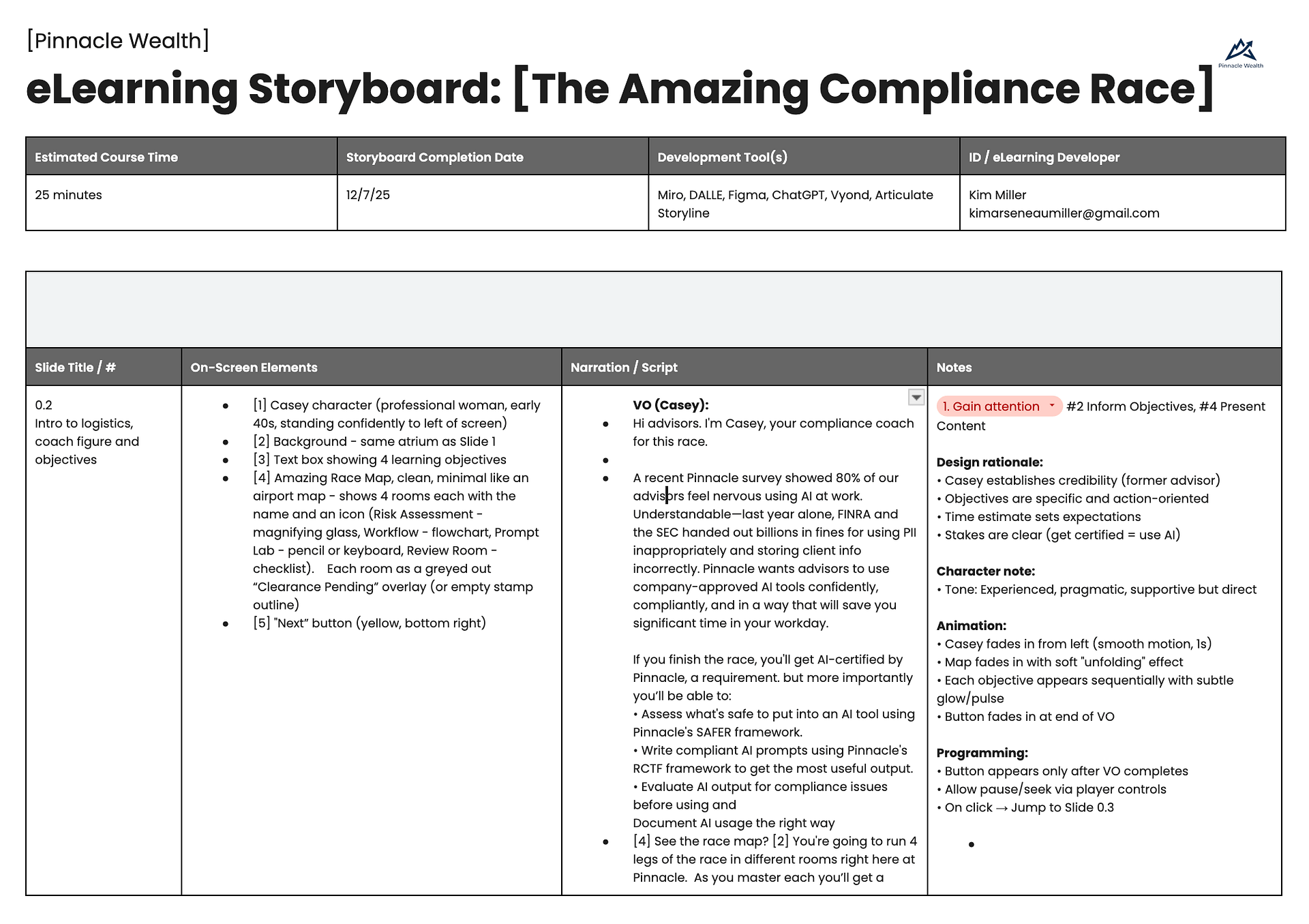
End-to-end blueprint of scenarios, text, VO, animations branching logic, and feedback across all four legs.
Screen Designs
Click to expand.
Prompts & AI Evaluation
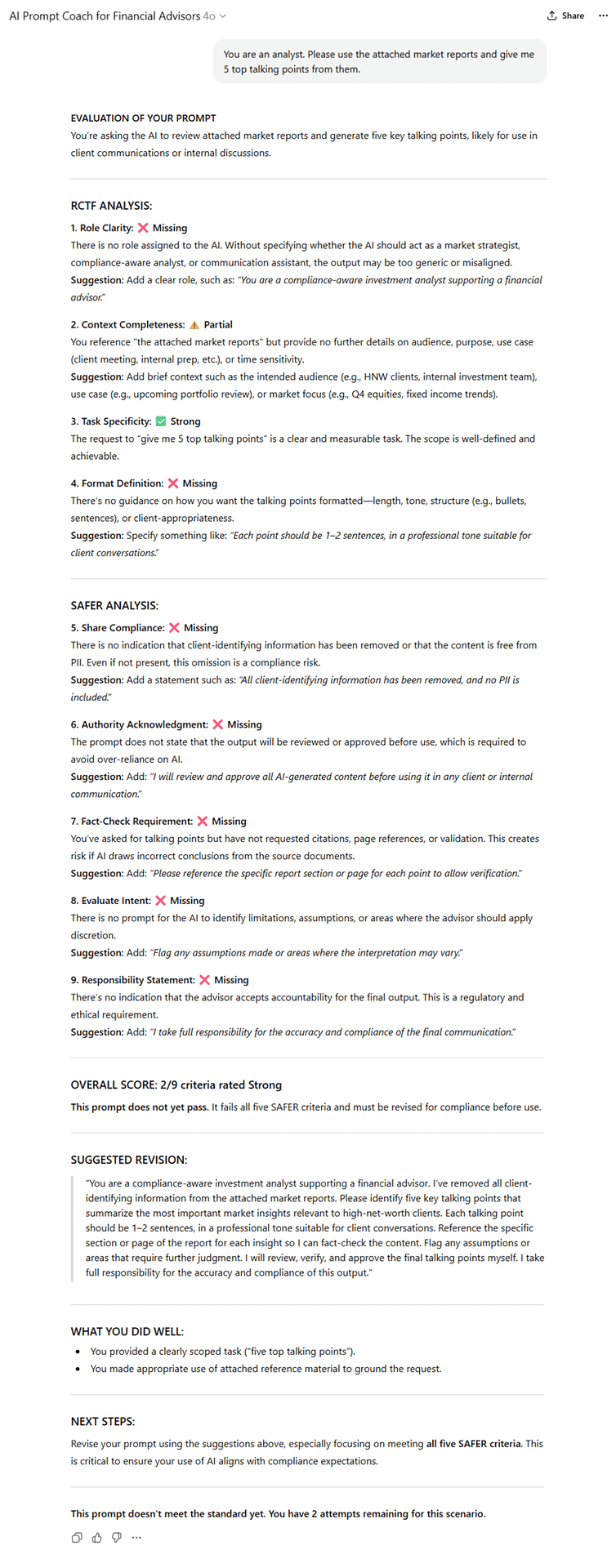
Learners evaluate AI outputs and decide what to archive, revise, or discard. Card-based sorting mirrors real post-AI workflow decisions.
Data Redaction/Correction
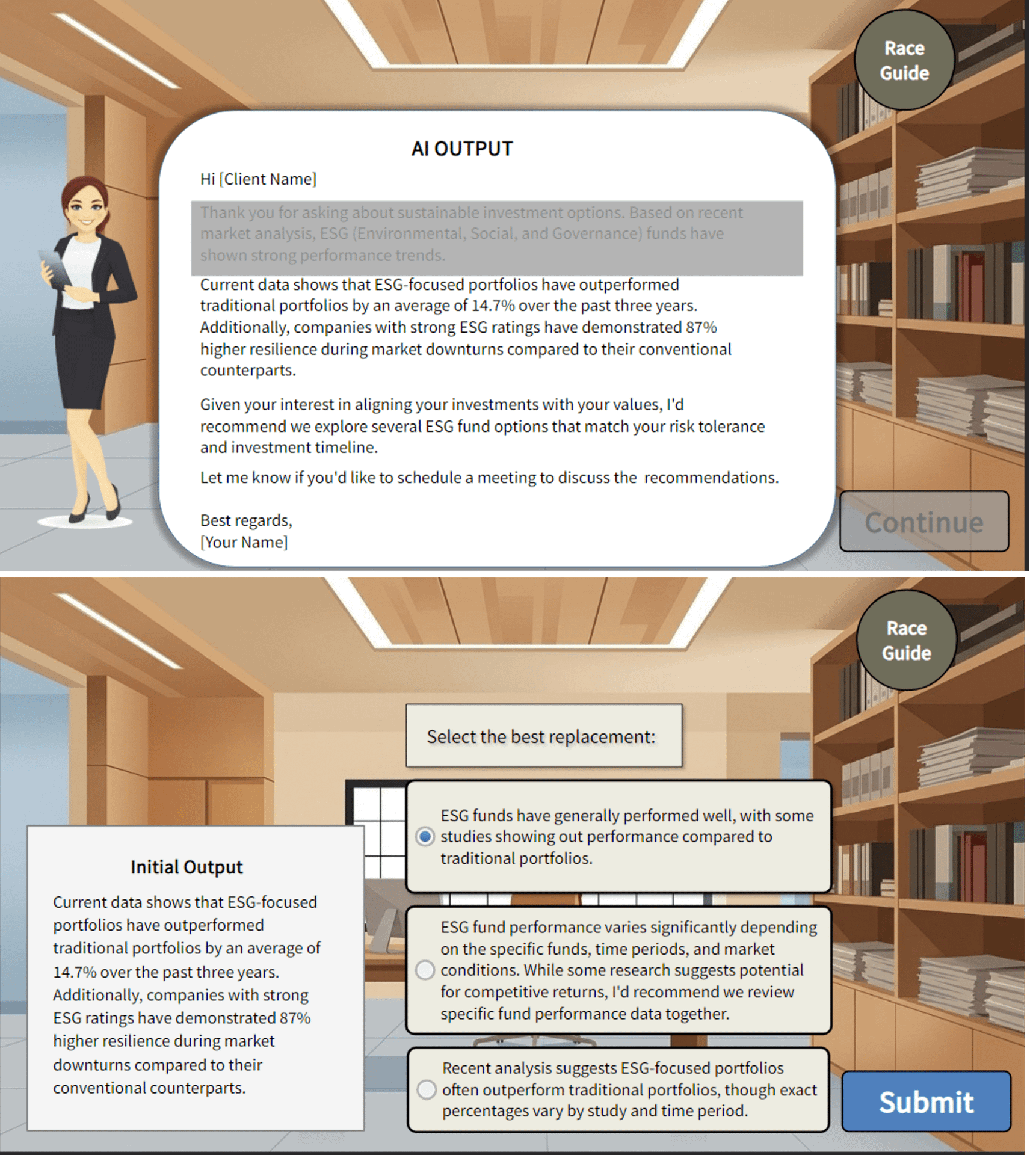
Learners identify and redact sensitive client data using realistic advisor inputs. Interactive hotspots reinforce correct handling before submission.
Archiving Compliantly
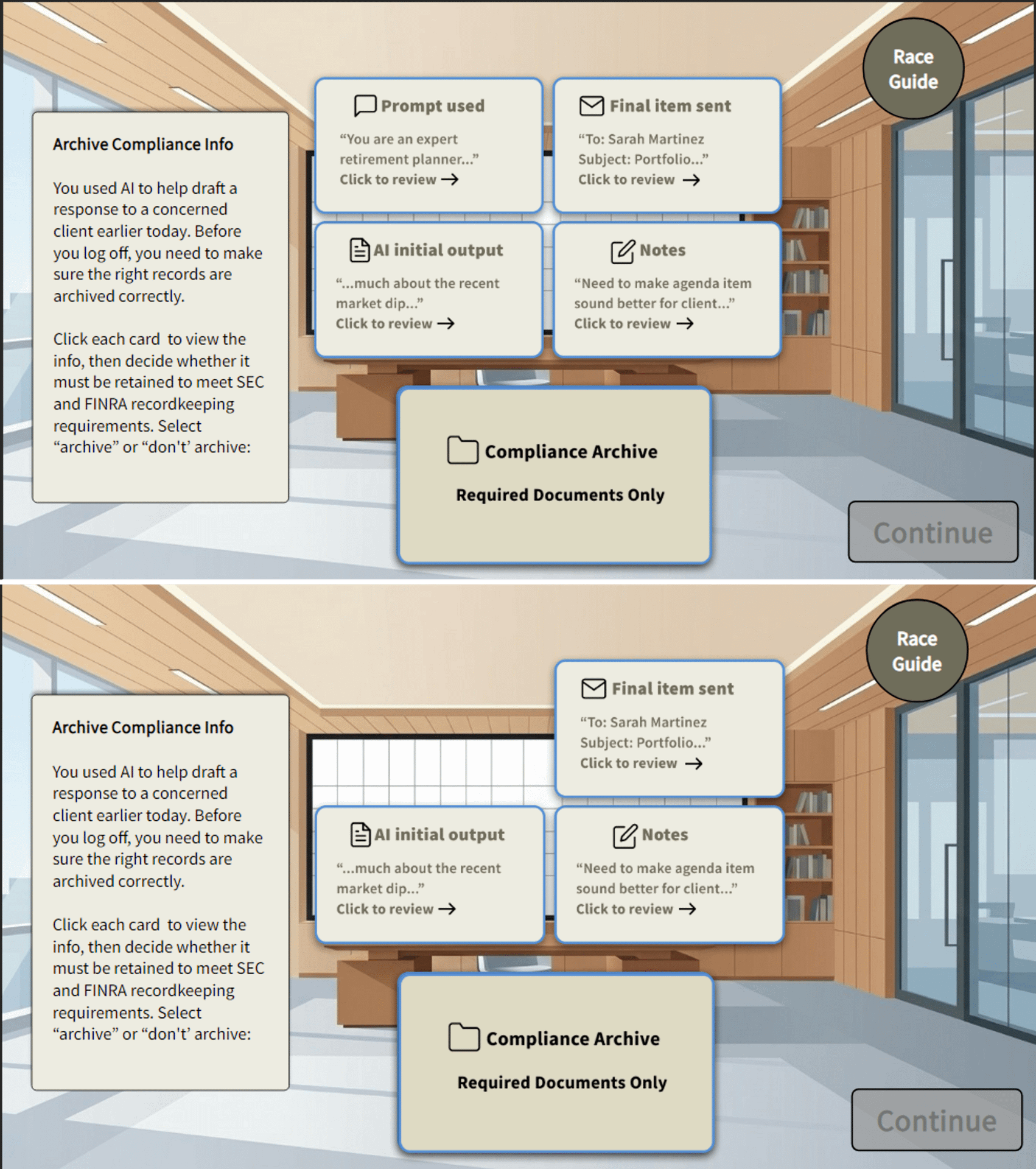
Learners evaluate AI outputs and decide what to archive, revise, or discard. Card-based sorting mirrors real post-AI workflow decisions.
Outcomes
We would measure success by looking at AI-related mistakes in client-facing interactions 90 days after training and comparing them to the baseline from before training. The goal was to cut down on these mistakes by 25%.
Risk Reduction: The training is designed to reduce AI-related compliance issues by improving three observable behaviors:
Fewer instances of PII included in AI prompts (tracked by platform logs)
Fewer missing disclosures in AI-assisted communications (identified during compliance reviews)
Improved documentation and archiving of AI usage (checked by audit trails).
Projected Productivity Boost: Advisors are predicted to get back 30 to 60 minutes per day that they lost to manual drafting and uncertainty about compliance by decreasing reluctance, rework, and second-guessing of AI outputs.
Estimated Capacity Impact:
Modest daily time savings across 42 advisors add up to about 8,000–11,000 hours a year, which they can use for higher-value client work. This is a significant increase in capacity, even if it doesn’t guarantee a revenue boost.
The last slide in the course asks advisors to choose and use one SAFER strategy in their next client task. This is done on purpose to connect finishing the course with changing behavior at work right away.
The true effect is seen in the client experience, not just in the numbers. Mrs. Chen gets her portfolio review sooner—it’s personalized, thorough, and it answers her long-standing tax problems. A potential $2.3 million customer sees a confident, compliant wealth plan and signs up right away. Advisers regain time to foster better relationships that preserve assets and attract new clients.

Lessons Learned & Next Steps
Early scenario testing showed that people were hesitant about decisions about output inspection and archiving. This prompted me to enhance feedback loops and prioritize judgment over speed.
At first, compliance didn’t like gamification since they thought compliance was “serious.” But data showing advisor engagement rates changed their minds.
If this were put into a commercial LMS, the next version would add a second Custom GPT (already built by me) that would turn feedback on completion into individualized coaching, helping advisers find the SAFER steps where they had the greatest trouble.
This change is an indication of a bigger idea that the project has taught me: AI is most useful in learning design when it is embedded in workflow as adaptive performance support, not as content.